

A manufacturer switching from conventional plastic to compostable production faces one critical decision: which compostable raw material goes into the hopper. PLA vs PBAT vs PBS pellets — each offers fundamentally different processing windows, mechanical outputs, and end-use certifications. Choosing the wrong pellet for a given production line results in warped parts, blocked film dies, or finished products that fail industrial compostability standards.
This guide compares all three compostable pellet families across the criteria that matter on the factory floor: melt flow behavior, heat resistance, compatibility with injection molding, film blowing, and thermoforming, and the real-world cost and supply landscape in 2026.
Three Polymer Families at a Glance
PLA (Polylactic Acid)
PLA is a bio-based polyester from fermented plant starch — corn, cassava, or sugarcane. PLA pellets command the largest market share due to high stiffness (50–70 MPa), excellent clarity, and a melt temperature of 160–180°C. Under EN 13432 / ASTM D6400) industrial composting, PLA biodegrades within 12 weeks at 58°C. Its primary limitation is brittleness — elongation at break under 5% for unmodified grades — which drives compounders to blend PLA with PBAT or impact modifiers for flexible applications.
PBAT (Polybutylene Adipate Terephthalate)
PBAT is a fossil-derived, fully biodegradable copolyester built for flexibility. PBAT pellets dominate compostable film because they process like LDPE on conventional blown-film lines, with melt temperatures of 110–130°C and elongation at break exceeding 500%. PBAT cannot stand alone in rigid applications — it is almost always blended with PLA, starch, or mineral fillers.
PBS (Polybutylene Succinate)
PBS occupies the middle ground: tensile strength of 30–40 MPa, elongation at break of 200–400%, and an HDT of 95–100°C — the highest among the three. This makes PBS pellets the top choice for hot-fill applications without requiring post-mold crystallization. PBS can be bio-based or petro-based, and is certified under EN 13432 with soil-biodegradable grades available (TUV OK).
PLA vs PBAT vs PBS Pellets: Head-to-Head Property Comparison
| Property | PLA | PBAT | PBS |
| Bio-based content | 100% (plant starch) | Petroleum-based (biodegradable) | 50–100% (varies by grade) |
| Tensile strength (MPa) | 50–70 | 15–25 | 30–40 |
| Elongation at break (%) | 2–5 | 500–700 | 200–400 |
| Melt temperature (°C) | 160–180 | 110–130 | 110–120 |
| Glass transition (Tg, °C) | 55–60 | -30 to -20 | -32 to -25 |
| Heat deflection temp (°C) | 50–55 | < 40 | 95–100 |
| Melt flow index (g/10min) | 3–30 (grade-dependent) | 2–10 | 5–25 |
| Industrial compostability | EN 13432, ASTM D6400 | EN 13432 | EN 13432 |
| Soil / home compostable | No (requires 58°C) | Possible (grade-dependent) | Yes (TUV OK soil) |
| Density (g/cm³) | 1.24–1.26 | 1.25–1.27 | 1.26 |
| Approx. pellet price (USD/kg, 2026 Q2) | 2.5–3.5 | 3.2–4.5 | 4.0–6.0 |
Sources: manufacturer TDS sheets; European Bioplastics market data 2025–2026.
Injection Molding: The PLA Stronghold with Exceptions
For injection molding, PLA pellets are the most widely adopted compostable raw material for cutlery, cups, lids, and containers. PLA’s high stiffness produces dimensionally stable parts at barrel temperatures of 170–190°C and mold temperatures of 20–40°C — parameters compatible with existing PET or PS tooling. Crystallization rate can be tuned with nucleating agents, giving molders control over cycle time without equipment changes.
For thin-wall hinged parts like container lids, neat PLA pellets risk brittle fracture. The standard fix is a PLA/PBAT compound (70/30 or 80/20) retaining over 80% stiffness while lifting elongation to 100–200%. These compound pellets run on the same injection molding machines with barrel temperatures lowered to 160–180°C.
PBS pellets enter injection molding where heat resistance is non-negotiable. A PBS spoon withstands 95°C liquid as-molded at processing temperatures of just 120–140°C. Standard PLA softens above 55°C. CPLA narrows the gap via post-mold annealing, but PBS eliminates that secondary step entirely.

Film Blowing: PBAT’s Uncontested Territory
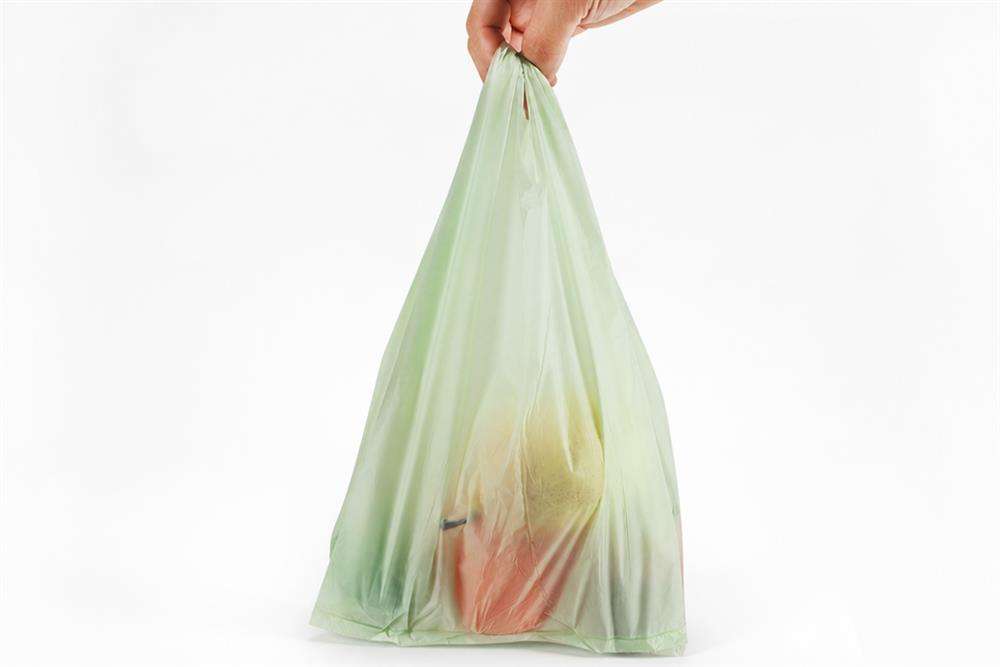
Film blowing demands high melt strength for bubble stability and sufficient elongation for stretching. PBAT pellets are purpose-built for this process, running on standard LDPE blown-film lines at blow-up ratios of 2:1 to 4:1, barrel temperatures of 130–160°C, and die temperatures of 140–150°C. The random copolyester architecture delivers melt elasticity that conventional polyethylene equipment demands, making PBAT pellets the backbone of compostable shopping bags, trash liners, and mulch films.
Neat PLA cannot be blown into film — its low melt strength causes bubble collapse. The workaround is PLA/starch blends (see our guide on PLA + starch flexible packaging), where thermoplastic starch provides the necessary elasticity. These compounds reach 20–30 µm thickness suitable for lightweight produce bags, though tear resistance remains below PBAT benchmarks. For film blowing with higher stiffness requirements, PBS film-grade pellets are gaining traction in agricultural mulch applications where faster soil-biodegradation kinetics and higher stiffness give them an edge over PBAT.
Thermoforming: PLA Leads, PBS Grows
In thermoforming, amorphous PLA pellets extrude cleanly into sheet and form with excellent definition at 90–110°C, producing clamshells, produce trays, and deli containers — the largest compostable thermoforming segment. The ceiling is service temperature: amorphous PLA distorts under hot food without crystallization. CPLA addresses this by crystallizing in-mold at 80–100°C, raising HDT to roughly 90°C at the cost of longer cycle times and visible whitening.
PBS thermoforms at 80–90°C with an as-formed HDT approaching 100°C — no post-crystallization needed. This makes PBS pellets the go-to compostable raw material for hot-food takeaway containers, though the 60–80% cost premium over PLA pellets limits adoption to applications where heat tolerance is non-negotiable. PBAT appears in thermoforming only as a minority seal layer in coextruded sheet for heat-sealable lidding.
Production Line Compatibility Matrix
| Process | PLA Pellets | PBAT Pellets | PBS Pellets |
| Injection molding | Excellent — standard grades available | Blend component only (with PLA) | Good — lower processing temp, high HDT |
| Film blowing | Requires starch/modifier blend | Excellent — runs on LDPE lines | Good — growing adoption in agri films |
| Thermoforming(sheet extrusion + forming) | Excellent — amorphous & CPLA grades | Not standalone (seal layer only) | Good — hot-food grade, premium cost |
| Extrusion coating | Acceptable (PLA coat on paper) | Good (flexible coating) | Limited adoption |
| 3D printing filament | Excellent | Not used | Niche |
| Fiber spinning (nonwoven) | Good (PLA fiber) | Limited | Emerging |

Cost and Supply Chain Reality
Price ranking: PBS > PBAT > PLA. PLA benefits from mature global capacity — NatureWorks (USA), TotalEnergies Corbion (Thailand), and multiple Chinese producers operating at hundreds of kilotons annually. PBAT capacity has expanded significantly in China (BASF ecoflex, Jinhuizhaolong), bringing FOB prices down substantially from the volatile 2022 peak. PBS remains the premium option with fewer producers; PTT MCC Biochem (Thailand, BioPBS) and Kingfa (China) are the primary global suppliers. Buyers should verify whether a PBS grade is bio-based or petro-based, as this affects marketing claims and, in some jurisdictions, subsidy eligibility.
PLA supply is the most diversified and least disruption-prone. PBS has the narrowest supply base — buyers committing to PBS-based production lines should secure agreements with at least two qualified sources. An increasing share of processors bypass single-polymer procurement entirely, opting for pre-compounded grades tailored to their specific process and end-use. A compounder combines PLA and PBAT in controlled ratios with processing aids and color masterbatch, delivering a drop-in pellet that eliminates the need for in-house blending equipment at a modest margin over raw resin cost.
FAQ
- Can I run PBAT pellets on my existing LDPE blown-film line without modification?
In most cases, yes. PBAT processes at the same temperature range as LDPE (130–160°C barrel, 140–150°C die) and forms a stable bubble with standard single-lip air rings at blow-up ratios of 2:1 to 4:1. Two adjustments matter: PBAT is more hygroscopic than LDPE — pre-dry at 60–80°C for 2–4 hours — and screw speed should be lowered slightly to manage shear heating. No hardware changes are typically needed.
- Which pellet type gives me a product that is both home compostable and heat resistant?
PBS is the only option meeting both criteria. Select grades with TUV OK biodegradable soil certification for home composting claims, paired with as-molded HDT of 95°C+ for hot-fill tolerance. Standard PLA fails home composting entirely (requires sustained 58°C), and PBAT lacks the rigidity and heat resistance for hot applications.
- For injection molding cutlery production, should I choose PLA or PBS pellets?
Depends on heat requirement. Cold-to-warm food: PLA at $2.5–3.5/kg wins on cost. Boiling water or 90°C+ food contact: PBS is functionally superior. Also evaluate CPLA compounds, which close much of the heat gap at a lower premium than PBS.
- What is the typical shelf life of products made from these three pellet types?
12–24 months under standard warehousing (20–25°C, <60% RH, no direct UV). PLA is most sensitive to high-temperature storage — sustained exposure above 40°C can initiate deformation. PBS and PBAT tolerate wider storage conditions.
- Are there any certification differences I should consider when comparing pellet suppliers?
Yes. Certification belongs to the specific pellet grade, not the polymer family. Verify the supplier’s grade holds current third-party certification (TUV, DIN CERTCO, or BPI) for EN 13432 / ASTM D6400. For Australia (AS 4736), confirm individually — not all EN 13432-certified grades automatically qualify.
Sourcing Compostable Pellets with Naturepoly
Selecting the right compostable pellet flows from the production line outward: film blowing lines need PBAT-dominant compounds, standard injection cutlery runs PLA, hot-food thermoforming calls for PBS. In many cases the optimal answer is a pre-compounded grade that eliminates in-house blending. At naturepoly, buyers are supported with technical-grade pellet recommendations matched to their process, certifications, and cost targets — because the most certified pellet still fails if it cannot run on the machine it is bought for.