
What Are BPI Certified Compostable Cups?
BPI Certified Compostable Cups are foodservice drinkware products that have been independently verified by the Biodegradable Products Institute (BPI) to meet strict compostability standards in commercial composting facilities. Unlike vague “eco-friendly” or “biodegradable” claims, BPI certification provides third-party assurance that these cups will fully break down under controlled composting conditions without leaving behind harmful residues.
To earn certification, BPI certified cups must comply with ASTM standards such as ASTM D6400 (for compostable plastics) or ASTM D6868 (for compostable coatings and linings). These standards confirm that the cups will disintegrate, biodegrade, and leave no toxic residue within an industrial composting environment. For businesses sourcing BPI compostable cups, this certification removes uncertainty and mitigates compliance risk.
It is important to distinguish between compostable and biodegradable. Biodegradable products may break down slowly over time, often without clear performance benchmarks, and can still leave microplastics behind. In contrast, BPI Certified Compostable Cups are designed to decompose into natural elements within a defined timeframe and align with municipal composting requirements.
For B2B buyers—such as cafés, restaurant chains, event organizers, and distributors—certification matters. Many cities and institutions now mandate certified compostable packaging to meet sustainability targets and waste diversion goals. Choosing BPI Certified Compostable Cups ensures regulatory compliance, protects brand credibility, and supports participation in a verifiable composting stream rather than landfill-bound “greenwashed” alternatives.
What Does BPI Certification Really Guarantee?

When evaluating sustainability claims, BPI certification provides clarity in a market crowded with misleading terminology. For BPI Certified Compostable Cups, certification guarantees that the product has passed rigorous third-party testing for compostability, disintegration, and environmental safety in commercial composting facilities. This is not a self-declared label or marketing claim—it is a verified standard backed by science.
Specifically, BPI certified cups must meet ASTM compostability benchmarks, confirming that the material will break down at a similar rate as organic waste, leave no toxic residues, and not compromise the quality of finished compost. This assurance is critical for composting operators, municipalities, and B2B buyers who need packaging that integrates cleanly into existing compost streams.
Just as importantly, BPI certification protects buyers from greenwashing. Products labeled only as “biodegradable” or “eco-friendly” may never fully decompose or may require conditions that do not exist in real-world waste systems. By choosing BPI Certified Compostable Cups, businesses can confidently align their packaging choices with environmental regulations, waste diversion programs, and corporate sustainability commitments.
Are Compostable Cups Really Compostable?
The short answer is: only if they are certified. The question are compostable cups really compostable arises because many products marketed as compostable fail to break down in actual composting environments. Without certification, there is no guarantee that a cup will disintegrate, biodegrade fully, or avoid leaving behind microplastics.
In industrial composting facilities, BPI certified cups are processed alongside food waste under controlled heat, moisture, and microbial activity. Certified cups typically disintegrate within weeks and fully biodegrade within the composting cycle defined by ASTM standards. Non-certified products—such as oxo-degradable plastics, PE-lined paper cups, or untested bioplastics—do not qualify as compostable and often contaminate compost streams.
In practical terms, BPI certification separates genuinely compostable packaging from misleading alternatives, ensuring that compostable cups perform as intended in real-world composting systems rather than merely sounding sustainable on paper.
Why Businesses Are Switching to BPI Certified Compostable Cups
Across the foodservice and hospitality industries, more companies are transitioning to BPI Certified Compostable Cups as sustainability moves from a branding choice to a business requirement. Regulatory pressure is one of the primary drivers. Local and national governments continue to introduce plastic bans, extended producer responsibility (EPR) rules, and waste reduction mandates that favor certified compostable packaging. For organizations with ESG commitments, BPI Certified Compostable Cups offer a verifiable way to demonstrate progress toward measurable environmental goals.
Consumer expectations are also reshaping purchasing decisions. Customers increasingly associate packaging with brand values, particularly in cafés, quick-service restaurants, and event settings. Using BPI compostable cups signals environmental responsibility in a way that vague “eco-friendly” claims cannot. Certification builds trust and reduces skepticism among environmentally conscious consumers.
From an operational standpoint, certified compostable cups support waste diversion initiatives. When paired with proper composting infrastructure, BPI Certified Compostable Cups can be collected with food waste and diverted from landfills, reducing overall disposal costs and contamination risks compared to mixed recycling streams.
While compostable cups may carry a higher unit price than conventional plastic, many businesses find the total cost competitive over the full lifecycle. Reduced landfill fees, regulatory compliance, brand value, and alignment with long-term sustainability strategies often outweigh the marginal cost difference, making BPI compostable cups a practical and forward-looking investment rather than a short-term expense.
Types of BPI Certified Compostable Cups (And When to Use Each)

Not all BPI Certified Compostable Cups are designed for the same applications. Material composition, temperature tolerance, appearance, and end use all play a role in selecting the right cup for your business. Understanding these differences helps buyers choose BPI certified cups that perform reliably while meeting sustainability and regulatory requirements.
Broadly, BPI compostable cups fall into categories such as cold cups, hot beverage cups, fiber-based cups, and specialty formats. Each serves a specific function within foodservice environments, from cafés and juice bars to events and institutional dining. Selecting the appropriate cup ensures product integrity, customer satisfaction, and proper compostability at end of life.
BPI Certified Compostable Cold Cups
BPI certified compostable cold cups are most commonly made from PLA, a plant-based biopolymer derived from renewable resources. These cups are ideal for cold beverages such as iced coffee, smoothies, juices, and soft drinks. Businesses seeking visual clarity often prefer bpi certified compostable cold cups clear, which offer a glass-like appearance while remaining fully compostable in industrial facilities.
Naturepoly’s PLA Cold Cup is designed for maximum transparency, making it well suited for beverage presentation in cafés, juice bars, and takeout operations. For brands that want a distinctive look or color-coded drink options, the PLA Color Cup provides the same compostable performance with enhanced visual differentiation.
When choosing between clear and colored PLA, transparency is typically favored for showcasing layered drinks or fresh ingredients, while colored PLA supports branding and operational organization. It is important to note that PLA-based BPI Certified Compostable Cups are intended for cold use only. Exposure to high temperatures can cause deformation, so these cups should not be used for hot beverages. Understanding these temperature limitations ensures proper performance while maintaining full compostability and certification compliance.
BPI Certified Compostable Coffee Cups
BPI certified compostable coffee cups are engineered to handle hot beverages while meeting strict compostability requirements. These cups are typically constructed from paperboard with a PLA lining, which provides heat resistance and liquid barrier performance without relying on conventional plastic. Unlike PE-lined cups, which cannot be composted or recycled effectively, PLA-lined bpi compostable coffee cups are designed to break down in industrial composting facilities.
Naturepoly’s PLA Paper Cup is well suited for cafés, quick-service restaurants, and takeaway beverage programs. It offers reliable insulation for hot drinks such as coffee and tea while supporting compliance with composting regulations. For coffee-focused businesses and QSR chains, switching to certified compostable coffee cups simplifies waste sorting and reinforces sustainability commitments at the point of sale.
Compostable Ice Cream & Specialty Cups
For frozen desserts and specialty foods, BPI compostable cups must perform under cold, moisture-heavy conditions without losing structural integrity. Naturepoly’s PLA Ice Cream Cup is designed specifically for ice cream, gelato, and chilled desserts, offering durability and food safety while remaining fully compostable in commercial facilities.
These specialty cups are commonly used by ice cream shops, dessert brands, and event vendors seeking certified compostable packaging that aligns with sustainability goals without sacrificing functionality.
Bagasse Cups: Plastic-Free, Fiber-Based Alternatives
Bagasse cups are a popular choice for businesses seeking BPI compostable cups made from natural fiber rather than bioplastics. Produced from sugarcane pulp, bagasse cups are rigid, heat-resistant, and free from plastic linings. Naturepoly’s Bagasse Cup offers a molded fiber solution that is both durable and compostable.
Compared to PLA, bagasse provides a more natural appearance and performs well for hot beverages and food service applications. These cups are best suited for cafés, cafeterias, and institutions prioritizing plastic-free packaging and straightforward compostability in commercial composting environments.
Compare Naturepoly’s BPI Certified Cups at a Glance
Choosing the right cup for your business is easier when you can quickly see how each option performs. The table below compares Naturepoly’s BPI Certified Compostable Cups by material, temperature range, color options, and ideal beverage types. Whether you need a clear cold cup for smoothies or a hot coffee cup for cafés, this guide helps you select the right product while ensuring full compostability.
Comparison of Naturepoly BPI Certified Cups
| Product | Material | Beverage Type | Temperature Range | Color Options | BPI Certified? | Ideal Use |
| PLA Cold Cup | PLA | Cold | 0–50°C | Clear | Yes | Smoothies, iced coffee, juices |
| PLA Color Cup | PLA | Cold | 0–50°C | Multiple | Yes | Branded drinks, juice bars |
| PLA Paper Cup | Paper + PLA lining | Hot | 0–100°C | White | Yes | Coffee, tea, QSR chains |
| PLA Ice Cream Cup | PLA | Cold | 0–50°C | Clear/White | Yes | Ice cream, gelato |
| Bagasse Cup | Sugarcane fiber | Hot/Cold | 0–100°C | Natural beige | Yes | Cafés, institutional use |
Choosing the Right BPI Certified Lid Matters More Than You Think
When sourcing BPI Certified Compostable Cups, lids are often overlooked—yet they play a critical role in performance, customer experience, and overall compostability. Even the most sustainable cup can fall short if paired with a non-compostable or incompatible lid. For businesses committed to certified composting programs, selecting matching lids ensures that the entire beverage package aligns with composting requirements.
Using compatible lids with BPI Certified Compostable Cups also improves operational efficiency. Properly fitted lids reduce leaks, spills, and customer complaints, particularly in takeout and delivery scenarios. From a compliance perspective, pairing cups with certified compostable lids helps avoid contamination in compost streams, which is a key concern for waste processors and municipalities. For buyers evaluating BPI certified cups, lids should be considered an essential component—not an afterthought.
PLA Lids vs CPLA Lids — What’s the Difference?
PLA and CPLA lids are designed for different temperature applications, and understanding the distinction is essential. PLA lids, such as Naturepoly’s PLA Lid, are best suited for cold beverages. They offer clarity, a secure fit, and reliable leak prevention for iced drinks, smoothies, and cold coffee served in compostable cold cups.
CPLA lids, including Naturepoly’s CPLA Lid, are engineered for higher heat resistance. Crystallized PLA undergoes a thermal treatment that increases durability, making CPLA lids suitable for hot beverages such as coffee and tea. This added heat tolerance helps maintain shape, prevent warping, and reduce leakage during transport.
By matching cold cups with PLA lids and hot cups with CPLA lids, businesses can ensure optimal performance while maintaining full compostability. This alignment enhances the usability of BPI Certified Compostable Cups across café, QSR, and takeout applications without compromising sustainability goals.
How BPI Certified Compostable Cups Support a Circular Economy

BPI Certified Compostable Cups play a meaningful role in advancing a circular economy by aligning packaging with organic waste recovery systems rather than landfill disposal. When supported by proper composting infrastructure, these cups can be collected alongside food scraps and processed in industrial composting facilities, where they break down into nutrient-rich compost instead of persisting as long-term waste.
For foodservice operators, combining food waste with BPI compostable cups simplifies waste sorting and improves diversion rates. Compostable packaging reduces contamination compared to traditional recycling streams, where food-soiled plastics and paper often end up rejected and landfilled. This integration supports more efficient food waste recovery and reduces the overall environmental footprint of single-use serviceware.
In closed-loop systems, compost generated from certified compostable products can be returned to agricultural use, helping regenerate soil and support renewable feedstock production. Compared to recyclable plastics—which rely on complex sorting, low recovery rates, and downcycling—BPI Certified Compostable Cups are designed for a defined end-of-life pathway. This predictability makes them a practical solution for businesses seeking packaging that supports circularity in real-world waste management systems, not just in theory.
What B2B Buyers Should Look for When Sourcing BPI Certified Cups
For procurement teams and foodservice operators, sourcing BPI Certified Compostable Cups requires more than comparing unit prices. Certification, performance consistency, and supplier reliability all directly impact compliance, customer experience, and long-term operational costs. Verifying that products are genuinely certified—and suitable for your specific use case—is essential when evaluating BPI certified cups for commercial deployment.
Buyers should request documentation confirming active BPI certification and applicable ASTM standards to ensure regulatory alignment. Beyond certification, factors such as customization options, compatible lids, and supply continuity can significantly affect rollout success, particularly for multi-location cafés, QSR chains, and distributors. Selecting the right supplier of BPI Certified Compostable Cups helps mitigate risk while supporting sustainability objectives.
Key Questions to Ask Your Supplier
- Can you provide current BPI certification proof?
Certification should be verifiable and specific to the product being purchased. - Do you offer custom branding or printing?
Private labeling and logo printing are important for brand visibility and differentiation. - What are your minimum order quantities (MOQs)?
MOQ flexibility matters for scaling, pilot programs, and regional distribution. - Are lids fully compatible and also compostable?
Cup-and-lid compatibility is critical for leak prevention and compost stream integrity. - How reliable is your supply chain?
Consistent lead times and production capacity are essential for uninterrupted operations.
Addressing these questions upfront enables buyers to confidently source BPI Certified Compostable Cups that meet performance expectations, sustainability standards, and long-term business needs.
Frequently Asked Questions About BPI Certified Compostable Cups
Can BPI certified cups go in home compost?
Most BPI Certified Compostable Cups are designed for industrial composting, not home compost systems. Commercial facilities provide the high heat, moisture, and microbial activity required to meet ASTM compostability standards. Home compost conditions are typically inconsistent and may not fully break down certified compostable cups within a reasonable timeframe.
Do compostable cups need special disposal?
Yes. To ensure proper end-of-life processing, BPI certified cups should be disposed of in designated commercial compost bins where available. Placing compostable cups in recycling or landfill bins undermines their environmental benefit. Clear labeling and staff or customer education can significantly improve correct disposal.
Are clear compostable cups plastic?
Clear compostable cups are commonly made from PLA, a plant-based biopolymer derived from renewable resources such as corn or sugarcane. While they resemble plastic in appearance, they are not petroleum-based plastics and are certified to compost in industrial facilities. This distinction often leads people to ask, are compostable cups really compostable—which is why certification is essential.
Are BPI compostable cups food-safe?
Yes. BPI Certified Compostable Cups are manufactured from food-contact–approved materials and are suitable for beverages and food service applications. Certification focuses on compostability, while food safety compliance ensures the cups meet applicable regulatory standards for safe consumer use.
Why Naturepoly’s BPI Certified Compostable Cups Stand Out
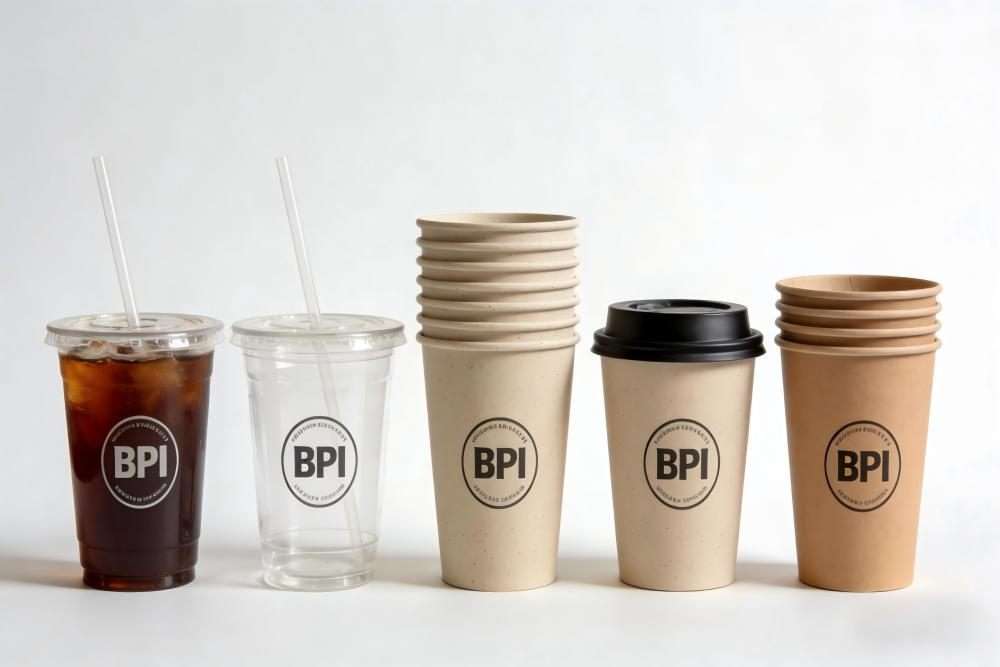
Naturepoly offers a complete range of BPI Certified Compostable Cups designed to meet the diverse needs of cafés, restaurants, event organizers, distributors, and private-label buyers. Unlike generic options, Naturepoly provides a full cup-and-lid ecosystem, ensuring that every component—from cold and hot cups to PLA and CPLA lids—is fully certified for industrial composting. This comprehensive approach simplifies sourcing and guarantees compatibility across products, reducing operational headaches and contamination risks.
Our BPI compostable cups are available in multiple materials, including PLA, paper, and bagasse, allowing businesses to select the ideal format for beverages, desserts, or specialty applications. Clear and colored PLA cups, paper cups with PLA lining, and fiber-based bagasse cups provide flexibility for presentation, branding, and functionality. Naturepoly also offers custom sizes, colors, and printing options, making it easy for businesses to maintain brand identity while supporting sustainability goals.
All products are backed by verified BPI certification, providing assurance that the cups will fully compost in industrial facilities, aligning with ESG initiatives and regulatory requirements. By choosing Naturepoly’s BPI Certified Compostable Cups, buyers invest in reliable, sustainable packaging solutions that enhance customer experience and support circular economy principles. Contact us
Explore our full range of BPI certified cups and lids to find the ideal solutions for your business.