
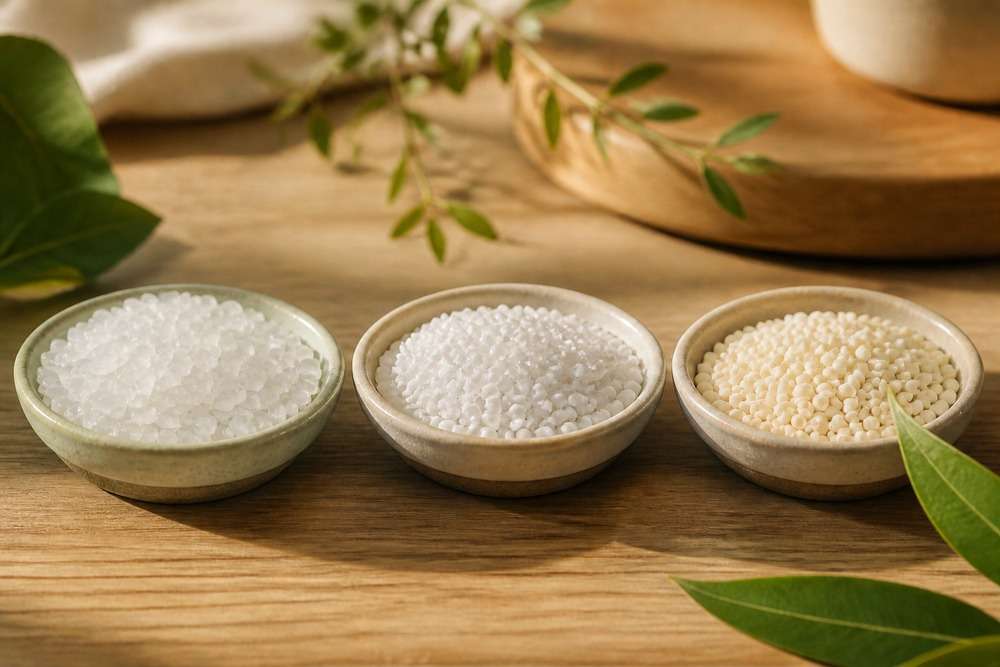
Choosing between PLA, PBAT, and PHA is one of the most consequential decisions a packaging buyer makes in 2026, because these three bioplastics dominate the compostable materials market yet behave very differently. PLA offers stiffness and clarity at the lowest cost, PBAT delivers the flexibility that films and bags demand, and PHA brings the broadest biodegradability — including home and marine composting — at a premium price. Matching the right material to your product is what separates a compliant, cost-effective launch from a costly misstep.
The stakes are rising as the bioplastics market scales toward a projected USD 15.9 billion in 2026, growing at roughly 20 percent a year. Buyers face a practical question: which of these three materials actually fits my product’s performance, compostability, and budget requirements? This guide breaks down the differences head-to-head, maps each material to its best applications, and gives you a clear framework for choosing.
What Are the Three Main Bioplastics?
The term “bioplastics” covers materials that are either bio-based, biodegradable, or both — and the three workhorses of the compostable packaging industry are PLA, PBAT, and PHA. Each comes from a different chemistry and therefore solves a different problem. Understanding those differences is the foundation of every material-sourcing decision in 2026, because performance, compostability, and cost all hinge on the chemistry.
PLA (Polylactic Acid)
Polylactic acid is fermented from plant sugars — typically corn, sugarcane, or cassava. It is stiff, transparent, and glossy, which makes it ideal for rigid applications such as cold cups, containers, and clear films. Its main limitation is heat: standard PLA softens at temperatures around 50–60°C, so hot-food applications require a crystallized form, commonly called CPLA, which offers significantly higher heat tolerance. PLA is also the most established of the three, with the deepest global supply chain and the lowest price point.
PBAT (Polybutylene Adipate Terephthalate)
PBAT is a biodegradable copolyester that, unlike PLA and PHA, is fossil-derived rather than bio-based. What it lacks in renewable feedstock it makes up for in performance: it is soft, elastic, and tough, closely resembling conventional polyethylene. That flexibility is why PBAT is the backbone of compostable films, shopping bags, and flexible packaging, and why it is often blended with PLA or starch to balance rigidity. Although PBAT is not bio-based, it is a fully biodegradable polymer that performs reliably in industrial composting.
PHA (Polyhydroxyalkanoate)
PHA is produced by microorganisms that ferment sugars or plant oils into a natural polyester. It is the newest and most versatile of the three, offering a tunable range of stiffness and flexibility, plus a standout advantage: PHA bioplastics biodegrade in home compost, soil, and even marine environments, not just in industrial facilities. Its cost, however, remains the highest of the three as production capacity scales up, which is why PHA is often reserved for premium and high-performance applications rather than commodity packaging.
PLA vs. PBAT vs. PHA: Head-to-Head Comparison
The table below summarizes the key differences among these three bioplastics at a glance. Use it as a reference when screening materials against your product requirements.
| Property | PLA | PBAT | PHA |
| Feedstock | Bio-based (plant sugars) | Fossil-based (biodegradable) | Bio-based (microbial) |
| Key properties | Stiff, transparent, brittle | Flexible, elastic, tough | Tunable, high-performance |
| Heat resistance | Low (CPLA for hot) | Low-moderate | Varies, some high |
| Biodegradation | Industrial compost only | Industrial compost only | Home, marine, and soil |
| Best applications | Cold cups, rigid containers, films | Bags, flexible films, liners | Premium cutlery, straws, films |
| Relative cost | Low | Low-moderate | High |
How to Choose the Right Bioplastics for Your Product
The right bioplastics for your product are the ones that match your functional demands, disposal environment, and unit economics. Work through these scenarios to narrow the field.
For rigid, cold-service packaging — cups, clamshells, and trays — PLA is usually the default, because it is the most affordable of the three and delivers the stiffness and clarity these formats need. If the item must hold hot food, switch to crystallized CPLA or a bagasse molded-fiber alternative.

For flexible packaging — bags, films, and liners — PBAT is the workhorse. It provides the stretch and tear resistance that PLA cannot, and it is the material most compostable bags are built around, usually blended with PLA or starch.

For premium or high-visibility items — cutlery, straws, and luxury packaging — PHA is worth evaluating. Its home and marine compostability is a genuine differentiator for brands that market their packaging as naturally biodegradable, and it justifies the higher price in premium segments.
In practice, most commercial compostable products are blends. PLA-PBAT blends balance stiffness and flexibility, while PHA is increasingly added in small percentages to accelerate degradation and improve mechanical performance. Before finalizing a material, validate it against real use conditions: request samples, test them with your actual product, and confirm the material performs as promised under heat, cold, and moisture.
A simple selection framework helps: define your three non-negotiables first, performance, disposal environment, and unit cost, then filter the materials against each one. Most teams find that one material eliminates itself on cost, another on compostability, and the winner becomes obvious once the trade-offs are explicit.
Compostability and Certification for Compostable Packaging Materials
Not all bioplastics degrade the same way, and “biodegradable” is not the same as “certified compostable.” PLA and PBAT generally require industrial composting conditions — elevated temperature and humidity — which means they are certified to standards such as ASTM D6400 or EN 13432 but will not reliably break down in a home compost pile. PHA, by contrast, biodegrades across a much wider range of environments. When reviewing certification, look for third-party marks such as BPI or TUV Austria, and confirm whether the certificate covers industrial composting, home composting, or both.

For buyers, the practical rule is to match the material to the disposal infrastructure your customers actually have. If your customers use industrial composting, PLA and PBAT work well. If you market to consumers who compost at home — or if your products risk ending up in the environment — PHA is the stronger choice. Always require the certification certificate, not just a logo.
Biodegradable Plastic Types: Cost, Supply, and Sourcing Considerations
Cost runs in a clear order: PLA is the most affordable and widely available, PBAT sits in the middle, and PHA remains a premium material as production capacity continues to scale. The PHA price in the United States reached roughly USD 3,700 per metric ton in mid-2026, well above typical PLA and PBAT pricing, reflecting both its performance advantages and its smaller, newer production base.
Supply reliability is the other consideration. PLA and PBAT have mature, globally distributed supply chains, while PHA capacity is concentrated among fewer producers and can be tighter to source at volume. For large programs, confirm lead times and line up multi-source supply before committing to a single material. Also factor in duties, freight, and any eco-modulated EPR fees, since these can shift the landed-cost math between materials.
Frequently Asked Questions
What is the difference between PLA, PBAT, and PHA bioplastics?
PLA is a stiff, transparent bio-based plastic for rigid cold-service items; PBAT is a flexible fossil-derived biodegradable copolyester for films and bags; and PHA is a versatile microbial bioplastic that degrades in home, marine, and soil environments. The right choice depends on performance, disposal, and budget.
Are PLA and PBAT home compostable?
Generally no. PLA and PBAT typically require industrial composting conditions and are certified to ASTM D6400 or EN 13432. PHA is the bioplastics option to choose if home or marine biodegradability is required.
Which bioplastic is the cheapest?
PLA is the most affordable of the three and has the most mature supply chain. PBAT is mid-priced, while PHA remains the premium option as its production capacity scales.
Which bioplastic should I choose for bags?
PBAT is the standard choice for flexible films and bags because of its elasticity and toughness, and it is usually blended with PLA or starch.
Is PBAT bio-based?
No. PBAT is fossil-derived but biodegradable, while PLA and PHA are bio-based, made from renewable plant or microbial feedstocks.
Choose the Right Bioplastics with a Verified Partner
Choosing among PLA, PBAT, and PHA comes down to matching performance, compostability, and cost to your product — and the right partner makes that decision simpler. At Naturepoly, we manufacture certified compostable foodservice packaging across PLA, CPLA, PBAT, and PHA, and we can help you select the best bioplastics blend for your application, budget, and target market. Contact Naturepoly today for material samples, certification documents, and a tailored quote.